The rowing machine is safe for the lower back when performed with proper technique. Pain results from three common errors: lumbar flexion at the catch (rounding forward), initiating the drive with the back instead of the legs, and hyperextending past neutral at the finish. Correcting these form errors eliminates the excessive lumbar loading. For people with existing back conditions, modified rowing (reduced range of motion, lower damper, leg-dominant drive) is often well-tolerated and beneficial.
Why Rowing Can Hurt the Lower Back
A single rowing stroke involves roughly 60% leg drive, 30% back extension, and 10% arm pull. When this ratio shifts — the back takes on a disproportionate share of the work — the erector spinae and lumbar stabilizers are overloaded relative to their designed contribution.
The problem compounds over volume. A moderate rowing session involves 2,000-4,000 strokes. Even a small technique error at each stroke accumulates into significant cumulative loading. A 5% increase in lumbar contribution per stroke across 3,000 strokes is 150 extra reps of lumbar overload — enough to produce strain, fatigue, or spasm.
The Three Technique Errors
Error 1: Lumbar Flexion at the Catch
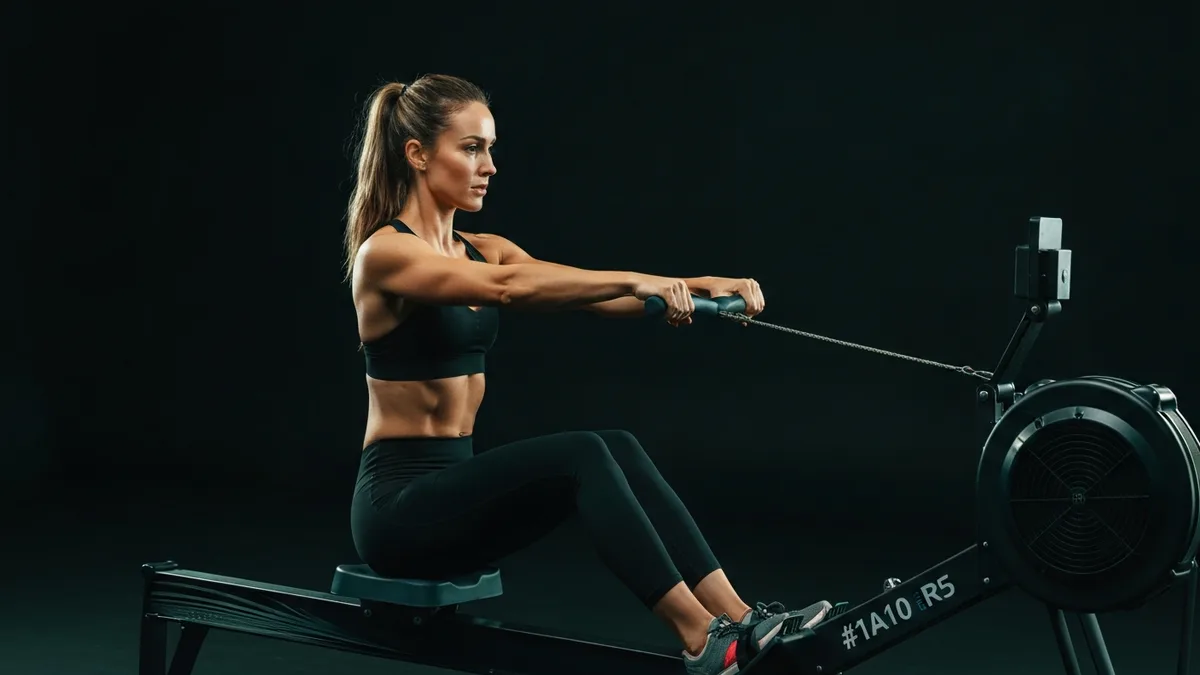
The catch is the forward position where the rower reaches toward the flywheel before initiating the drive. Many rowers reach too far forward, collapsing the thoracic and lumbar spine into flexion to gain extra range. This places the lumbar discs and posterior ligaments under stretch loading at the exact moment force is about to be applied.
The combination of lumbar flexion plus explosive leg drive is the same injury mechanism as a rounded-back deadlift — but repeated thousands of times per session.
Fix: Stop the forward reach where the lower back begins to round. For most people, this means the shins reach approximately vertical and the torso angles forward no more than 10-15 degrees past vertical. Cue: "chest proud at the catch" — if you cannot maintain an open chest, you have reached too far.
Error 2: Back-First Drive
The drive sequence should be legs → back → arms. When the back opens before the legs have completed their extension, the erectors bear the full resistance while in a mechanically disadvantaged forward-leaning position. The legs are the strongest link in the chain and should do the heaviest work.
Fix: The back stays at its catch angle until the legs are approximately 60-70% extended. Only then does the torso begin swinging open. Cue: "push the footboard away first" — the seat should move before the shoulder position changes.
Error 3: Hyperextension at the Finish
Leaning excessively far back at the finish of the stroke (past 10-15 degrees behind vertical) forces the lumbar spine into hyperextension under load. The handle is being pulled toward the chest while the spine is arched backward — compressing the posterior spinal structures (facet joints, spinous processes) and loading the erectors at their shortest, weakest length.
Fix: The finish position should be approximately 10-15 degrees past vertical. The lean should come from the hip, not from arching the lower back. Cue: "lean from the hips, not the spine."
The Correct Drive Sequence
| Phase | Body Action | Lower Back Role |
|---|---|---|
| Catch | Shins vertical, torso angled forward 10-15°, spine neutral | Isometric hold — maintains neutral position |
| Leg drive (60%) | Legs extend, torso angle stays constant | Isometric hold — transfers leg force to handle |
| Back swing (30%) | Torso swings from forward lean to slight back lean | Concentric contraction — controlled extension |
| Arm pull (10%) | Arms pull handle to lower chest | Isometric hold — maintains lean angle |
| Finish | Slight back lean (10-15°), legs straight | Isometric hold — stabilizes position |
Notice that the lower back performs an isometric hold for most of the stroke. It only contracts concentrically during the brief back-swing phase. When technique errors shift more work to the back, this isometric-dominant pattern becomes a concentric-dominant one — dramatically increasing fatigue and injury risk.
Rowing with an Existing Back Condition
For people with current lower back issues, rowing can be modified to remain safe:
Reduce damper setting. A damper setting of 3-5 provides adequate resistance for conditioning without the high forces of settings 8-10. Higher damper settings increase the force required per stroke, directly increasing lumbar load.
Shorten the stroke. Limit the catch position — do not reach as far forward. A shorter stroke reduces the range through which the spine must be stabilized and eliminates the deep flexion position that is most provocative.
Prioritize rate over power. Rowing at a higher stroke rate (26-30 strokes per minute) with lower force per stroke produces comparable cardiovascular stimulus with less spinal loading per stroke than rowing slowly (18-22) with high force.
Duration management. Start with 10-minute sessions and increase by 2-3 minutes per week as tolerated. The erector endurance that allows comfortable longer sessions builds progressively.
Building Rowing-Specific Back Resilience
Isometric lower back exercises directly build the sustained contraction capacity that rowing demands. The McGill curl-up, bird dog, and side plank build the endurance base. Back extensions at moderate intensity (2-3 sets of 15-20 reps) build the erector-specific endurance that allows the back to sustain its stabilizing role across thousands of strokes.
Cable rows performed with strict form teach the body the correct pulling sequence and build the lat and rhomboid strength that reduces compensatory back loading during the arm-pull phase of the rowing stroke.