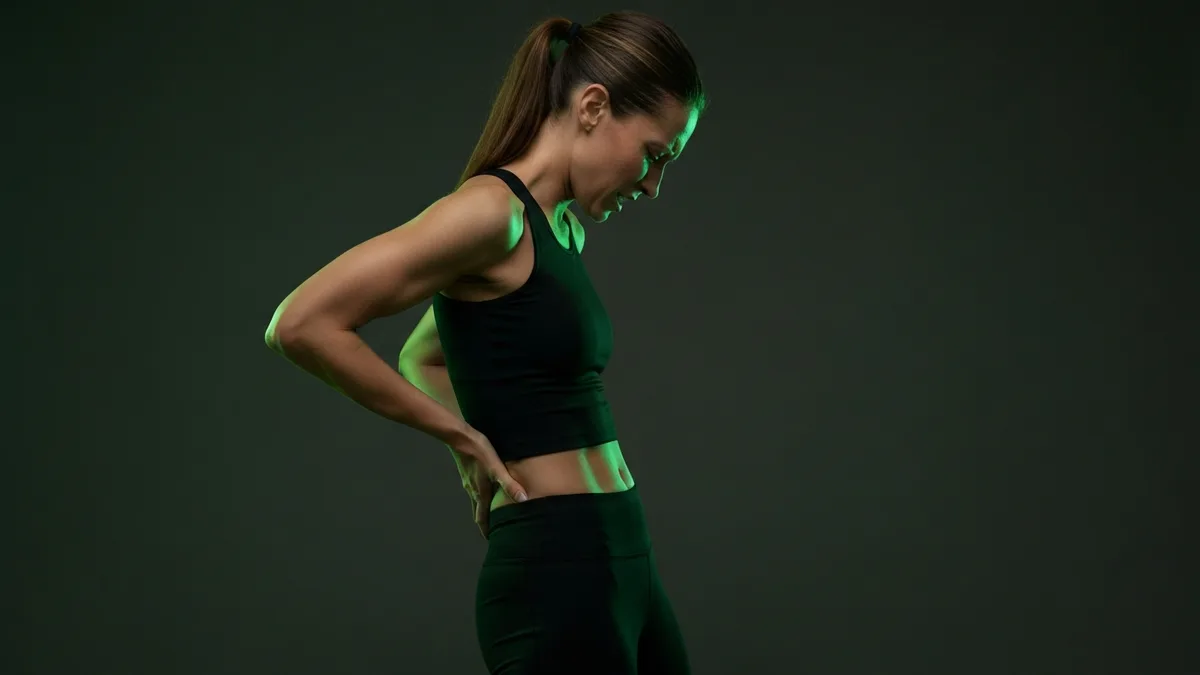
Lower back pain after deadlifts is most commonly caused by lumbar flexion under load (rounding), excessive volume relative to current capacity, or insufficient erector spinae endurance. The lower back muscles work isometrically during the deadlift to hold the spine rigid while the hips and knees produce movement — when these stabilizers fatigue or are overloaded, pain results from either muscular strain or excessive spinal compression.
Normal Tightness vs. Injury
The first question after any painful deadlift session is whether you are experiencing muscular fatigue or tissue damage. The distinction is usually clear:
| Sign | Normal Post-Deadlift | Potential Injury |
|---|---|---|
| Pain type | Dull tightness, pump feeling | Sharp, stabbing, or burning |
| Location | Bilateral, across the lower back | One-sided, pinpoint location |
| Duration | Resolves within 24-48 hours | Persists beyond 72 hours |
| Radiation | Stays in the lower back | Travels into glute, hip, or leg |
| Movement effect | Feels better with gentle movement | Worsens with movement |
| Next-day pattern | Stiff in morning, improves | No improvement or worsening |
If your symptoms fall consistently in the right column, stop training and follow the acute management protocol in our pulled back muscle guide. If radiating leg pain or neurological symptoms are present, see our pinched nerve guide.
Common Causes
Lumbar Flexion Under Load
This is the single most common cause of deadlift-related lower back pain. When the lumbar spine rounds during the pull — especially during the initial lift-off or when grinding through a heavy rep — the compressive and shear forces on the lumbar discs and ligaments increase dramatically. The erectors lose their mechanical advantage in a flexed position, meaning they must produce more force to resist further rounding, and the passive structures (discs, ligaments) absorb load they are not designed to handle repeatedly.
Lumbar flexion happens for three reasons: the weight exceeds what your erectors can stabilize isometrically, your hip-hinge patterning is insufficient (the lower back moves before the hips), or fatigue accumulates across sets and your form degrades on later reps.
Erector Spinae Fatigue
The erectors hold an isometric contraction for the entire duration of each set. In a set of 5 reps at a controlled tempo, that is 20-30 seconds of sustained maximum-effort isometric work. Across 4-5 heavy sets, the cumulative fatigue can exceed the muscle's endurance capacity even if each individual rep has acceptable form.
When this happens, the last few reps of the last few sets are where form breaks down — and where injury is most likely. If your lower back pain consistently appears after high-volume deadlift sessions but not lower-volume ones, erector endurance is the bottleneck. Isometric lower back exercises and back extensions build the endurance capacity to tolerate higher deadlift volumes safely.
Hip Stiffness Compensation
When the hips lack adequate flexion range, the lumbar spine compensates by flexing to reach the bar. This is the "tucked pelvis at the bottom" pattern — the lifter's hips stop hinging, and the remaining range of motion comes from the lower back rounding. They reach the bar, but the starting position already has the spine in a compromised posture before any force is applied.
The fix is not just stretching the hamstrings and hip flexors (though that helps) — it is recognizing the mobility limitation and adjusting the deadlift setup to work within your current range. Elevating the bar on blocks or using a hex/trap bar reduces the range-of-motion demand. As hip mobility improves, the bar can be lowered progressively.
Inadequate Bracing
Intra-abdominal pressure — the valsalva maneuver and conscious core bracing — provides approximately 40% of the spinal stiffness during heavy lifting. The erectors provide the rest. When bracing is insufficient, the erectors bear a disproportionate load. Lifters who breathe at the bottom of the deadlift, fail to brace before initiating the pull, or exhale during the hardest portion of the lift lose this protective mechanism at the worst possible moment.
Form Fixes
The setup determines the pull. Most deadlift form errors are not execution problems — they are setup problems. If the starting position is wrong, no amount of cueing will fix the movement.
Hips at the right height. Too high and the lift becomes a stiff-leg deadlift that maximizes erector demand. Too low and it becomes a squat-pattern with an excessively upright torso. The right hip height places the shoulders directly over or slightly in front of the bar, with the shoulder blades over the bar. For most lifters, this puts the hips roughly between knee and shoulder height.
Brace before you pull. Take a full breath into the abdomen (not the chest), tighten the core as if bracing for a punch, and lock that position before pulling the slack out of the bar. The brace should be established before any upward force is applied.
Pull the slack out of the bar. Before the plates leave the ground, create tension through the entire posterior chain by pulling upward against the bar until it contacts the top of the plate holes. This eliminates the jerking motion that catches the lower back unprepared.
Push the floor away. The mental cue of pushing the floor away (rather than pulling the bar up) keeps the hips as the primary driver and prevents the common error of the hips rising faster than the shoulders — which forces the erectors to extend the spine under load.
Modification Options
If conventional deadlifts consistently produce lower back pain despite form corrections, these modifications reduce lumbar demand while maintaining the training stimulus:
| Variation | How It Helps |
|---|---|
| Hex/trap bar deadlift | Reduces lumbar moment arm; more upright torso reduces erector demand by 10-20% |
| Sumo deadlift | Shorter moment arm at the lumbar spine; more upright torso |
| Block pull / rack pull | Reduces range of motion; eliminates the most flexed starting position |
| Romanian deadlift | Starts from standing; no flexed starting position; sustained tension builds erector endurance |
These are not inferior versions of the deadlift — they are appropriate programming choices that match the exercise to the lifter's current capacity. Progressing to a full conventional deadlift from one of these variations is a valid path.
When to Stop a Session
Stop the deadlift session immediately if sharp pain occurs during a rep (not just tightness), your form has deteriorated to the point where you are consciously compensating, pain does not resolve between sets, or you feel a pop, snap, or tearing sensation.
Stopping a session is not failure — it is the single most effective injury prevention decision you can make. The rep that causes a strain is almost always one that should not have been attempted.
Returning After an Injury
After a back muscle strain, return to deadlifting follows a predictable progression: isometric stability work first (bird dogs, side planks), then bodyweight hip hinges, then light back extensions, then RDLs at 40-50% of pre-injury deadlift weight, and finally conventional or sumo deadlifts with conservative loading.
Each phase should be pain-free before progressing. The entire return can take 2-8 weeks depending on injury severity. Rushing this timeline is the most common cause of re-injury and chronic lower back pain in lifters.
For barbell-based alternatives during recovery, good mornings and light RDLs maintain the hip-hinge pattern at lower spinal loads. For kettlebell alternatives, swings and single-leg deadlifts rebuild reactive stability.