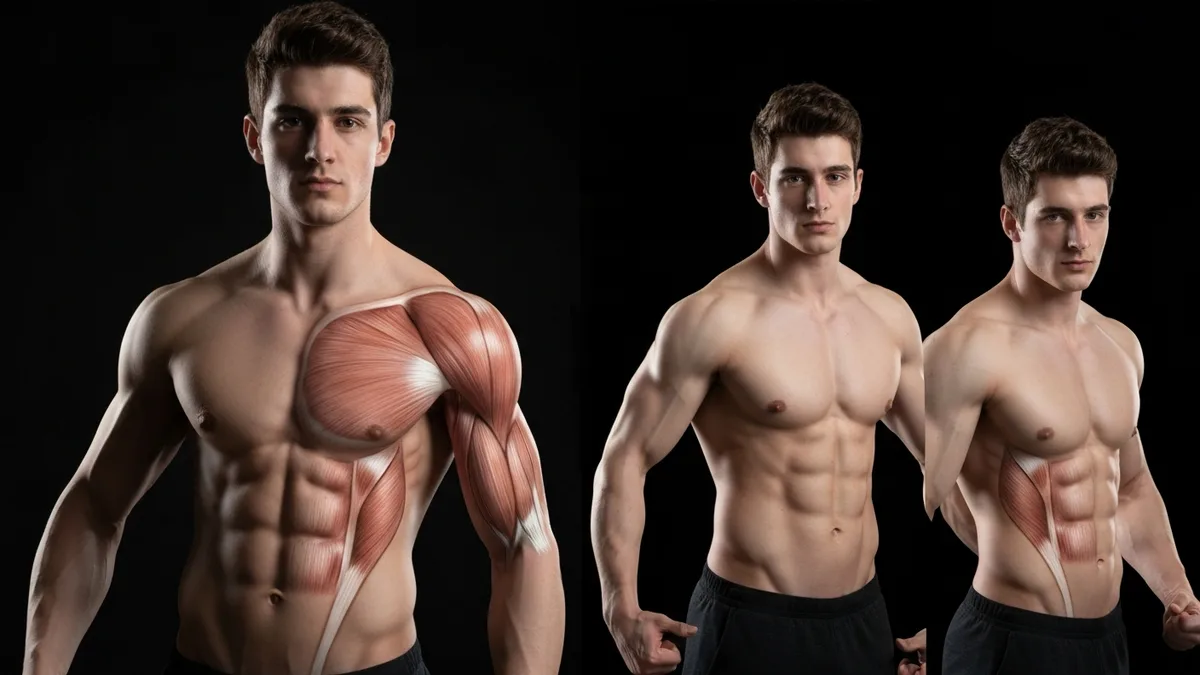
Your back contains over 40 muscles organized into three functional layers. The superficial layer (lats, traps) handles pulling and shoulder movement. The intermediate layer (rhomboids, serratus posterior) controls scapular positioning. The deep layer (erector spinae, multifidus) stabilizes your spine during every loaded movement.
Superficial Back Muscles
The superficial layer sits closest to the skin and includes the muscles most visible in a developed physique. These are the prime movers during pulling exercises.
Latissimus Dorsi
The latissimus dorsi is the widest muscle in the human body. It originates from the thoracolumbar fascia, iliac crest, and lower six thoracic vertebrae, inserting into the intertubercular groove of the humerus. Its primary actions are shoulder extension, adduction, and internal rotation — the exact movements you perform during lat pulldowns and pull-ups.
The lats respond strongly to both vertical pulling (pulldowns, chin-ups) and horizontal pulling (rows). Grip width and hand position shift emphasis across different fiber regions. A wide-grip cable row hits the upper lat fibers, while a close-grip underhand row targets the lower fibers near the iliac crest.
Trapezius
The trapezius is a large diamond-shaped muscle divided into three functional regions. The upper traps elevate the scapulae (shrugging). The middle traps retract the scapulae (squeezing shoulder blades together during rows). The lower traps depress and upwardly rotate the scapulae — a critical function during overhead pressing and pulldown movements.
Trap dominance during rows is one of the most common form issues. When the upper trapezius takes over, it reduces lat activation and can lead to trapezius muscle pain and tension headaches over time.
Intermediate Back Muscles
Rhomboid Major and Minor
The rhomboid muscles sit beneath the trapezius, connecting the medial scapular border to the thoracic spine. Rhomboid major is the larger of the two, while rhomboid minor sits just above it. Together, they retract and downwardly rotate the scapulae.
Weak rhomboids contribute to rounded shoulders and poor posture. They fire hardest during rowing movements with a pronounced squeeze at end range — seated cable rows with a pause at contraction are one of the best ways to target them. Rhomboid pain is common in desk workers and often responds well to targeted strengthening.
Teres Major and Teres Minor
Teres major works alongside the lat during shoulder extension and internal rotation. It originates from the inferior angle of the scapula, giving it a mechanical advantage during the bottom portion of pull-ups.
Teres minor is part of the rotator cuff and performs external rotation. It works as a stabilizer during most back exercises rather than a prime mover, but it plays a key role in preventing shoulder impingement during overhead pulling.
Deep Back Muscles
Erector Spinae Group
The erector spinae runs the full length of the spine from sacrum to skull. It consists of three columns: iliocostalis (lateral), longissimus (middle), and spinalis (medial). These muscles extend and laterally flex the spine, and they contract isometrically during every compound lift to keep your torso rigid.
The erectors are the primary target during back extensions and they work as powerful stabilizers during deadlifts and barbell rows. Erector spinae pain is one of the most common complaints among lifters and is usually caused by overloading before adequate strength is built.
Multifidus
The multifidus consists of short, powerful muscle fibers that span 2-4 vertebral segments. It provides segmental stability to the spine and works constantly during loaded movements. Research consistently shows that multifidus atrophy is associated with chronic lower back dysfunction.
Unlike the erector spinae, the multifidus does not respond well to heavy loading. It activates best during controlled, low-load movements like bird dogs and dead bugs, and through isometric holds during compound exercises.
How Back Muscles Work Together
No back muscle works in isolation during real-world movement or training. A single barbell row rep recruits the lats and teres major as prime movers, the rhomboids and middle traps as scapular retractors, the rear delts as shoulder extensors, the erector spinae as spinal stabilizers, and the multifidus for segmental control.
Understanding these relationships helps you build a training program that covers all back muscle groups without redundancy. The key is balancing vertical pulls (lat-dominant), horizontal pulls (rhomboid and mid-trap dominant), and hip-hinge movements (erector and posterior chain dominant).
| Muscle | Primary Action | Best Exercise Category | Common Issues |
|---|---|---|---|
| Latissimus dorsi | Shoulder extension, adduction | Vertical pulls (pulldowns, pull-ups) | Underdeveloped lower fibers |
| Trapezius (upper) | Scapular elevation | Shrugs, upright rows | Overactive in desk workers |
| Trapezius (mid/lower) | Scapular retraction, depression | Rows, face pulls | Weakness causing rounded shoulders |
| Rhomboids | Scapular retraction | Rows with squeeze | Pain from prolonged sitting |
| Erector spinae | Spinal extension | Back extensions, deadlifts | Strain from overloading |
| Multifidus | Segmental spine stability | Anti-rotation, isometrics | Atrophy in chronic back pain |
Training Implications
A complete back training program needs three movement patterns to cover all muscle groups. Vertical pulls target the lats and teres major. Horizontal pulls target the rhomboids, mid-traps, and rear delts. Hip-hinge movements target the erector spinae and posterior chain.
Most lifters over-emphasize vertical pulling and neglect the upper back retractors and lower back stabilizers. If you are building a back and bicep workout, make sure you include at least one movement from each pattern.
For exercise volume guidance, see our article on how many back exercises per workout and how many back sets per week.