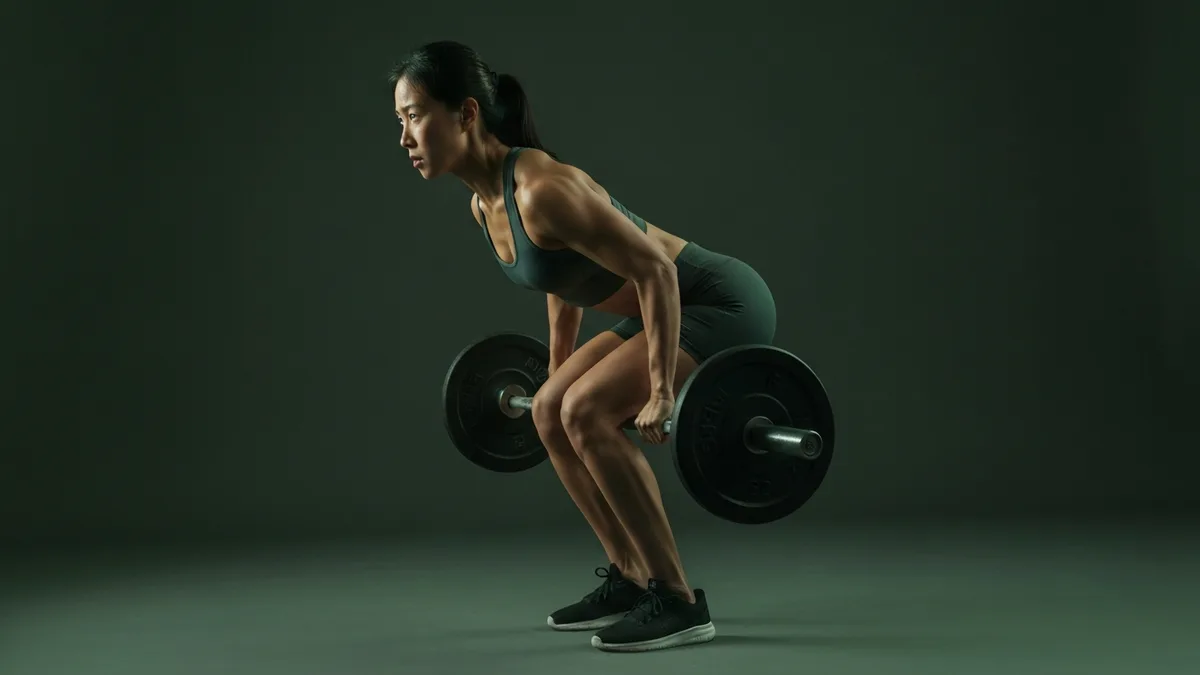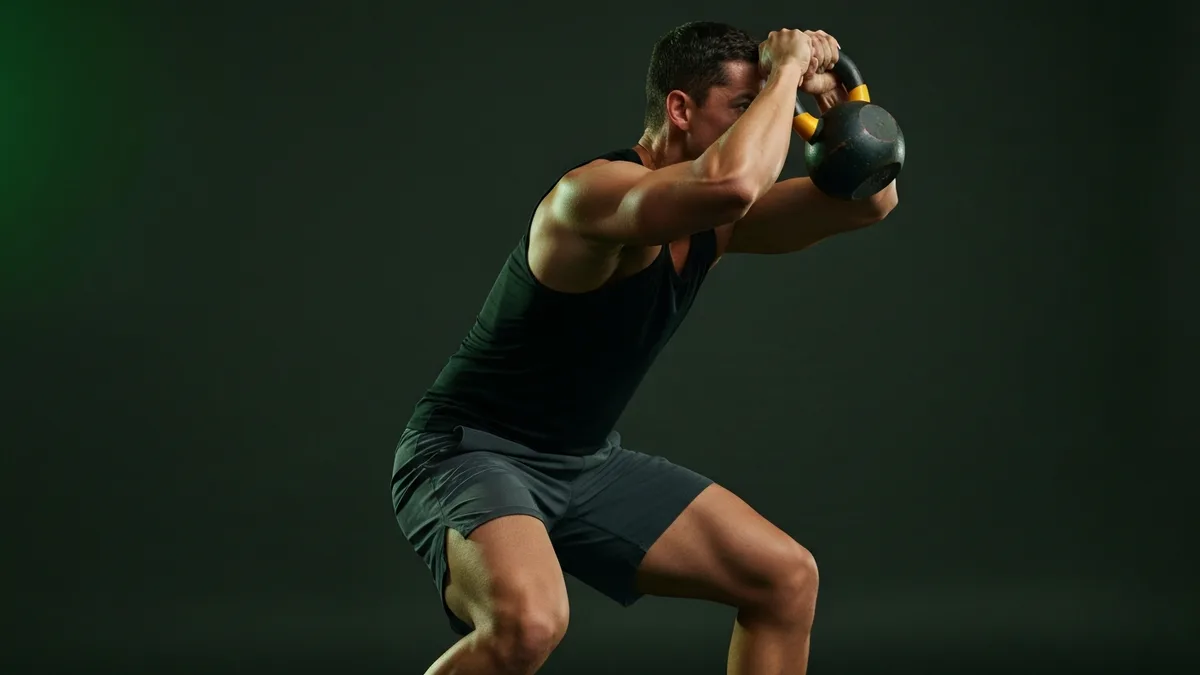
Kettlebells train the lower back through dynamic hip hinges (swings), offset loading (Turkish get-ups, suitcase carries), and single-leg stability (single-leg deadlifts). The ballistic and asymmetric nature of kettlebell training builds reactive spinal stiffness — the ability to stabilize the spine against rapidly changing forces — which transfers directly to athletic performance and daily functional demands.
Kettlebell Swing
The swing is the foundational kettlebell lower back exercise. It trains the erector spinae to stabilize the spine during explosive hip extension — a demand pattern that barbells do not replicate. The erectors must brace against both the hip-hinge descent and the rapid acceleration of the upswing, building the reactive stiffness that protects the spine during sprinting, jumping, and sudden movements.
Form essentials: The swing is a hip hinge, not a squat. The bell travels between the upper thighs on the backswing while the torso hinges forward to roughly 45 degrees. The upswing is driven entirely by aggressive hip extension — the arms are passive connectors. The spine remains neutral throughout. If the lower back rounds at the bottom of the swing, the bell is descending too low or the hinge is insufficient.
Common mistake: Using spinal extension to power the upswing instead of hip drive. If you feel the swing in your lower back more than your glutes, the movement is coming from the wrong joint. The glutes should feel like the engine; the lower back should feel like the frame.
Programming: 3-5 sets of 10-15 reps. Start with the two-hand swing and progress to single-arm swings once the hip-hinge pattern is automatic.
Kettlebell Single-Leg Deadlift
The single-leg deadlift is the most demanding lower back stability exercise in the kettlebell repertoire. Standing on one leg while hinging forward with a kettlebell in the opposite hand creates simultaneous demands for hip-hinge strength, anti-rotation stability, and single-leg balance.
The erectors and quadratus lumborum work overtime to prevent the pelvis from rotating and the spine from laterally flexing toward the loaded side. This addresses a stability gap that bilateral exercises cannot touch — the ability to stabilize the spine during asymmetric loading.
Form essentials: Hold the kettlebell in the hand opposite the standing leg. Hinge at the hip, letting the rear leg extend behind you as a counterbalance. The bell should descend along the standing leg's shin. The hips stay square to the ground — any opening or rotation means the load is too heavy or the movement is too fast.
Programming: 3 sets of 8-10 per side, using a moderate weight that allows full control. This is a precision movement, not a strength movement — if form deteriorates, reduce the load before reducing the reps.
Turkish Get-Up
The Turkish get-up trains the entire body through a full range of positions — supine to standing and back — while stabilizing a kettlebell overhead. For the lower back specifically, the get-up demands sustained spinal stability through flexion, extension, rotation, and lateral bending transitions, all under load.
No other exercise replicates this demand pattern. The erectors, multifidus, obliques, and quadratus lumborum must adjust continuously as the body moves through seven distinct positions. This builds the adaptable stability that fixed-position exercises like planks and bird dogs cannot fully replicate.
Programming: 2-3 sets of 1-3 reps per side with a moderate weight. The get-up is a skill movement — each rep should take 30-45 seconds. Rushing produces sloppy transitions where the spine loses its neutral position.
Goblet Squat
The goblet squat loads the spine with the weight held at chest height, creating an anterior moment that the erectors must resist. The front-loaded position promotes a more upright torso than back squats, making it accessible for people with limited thoracic mobility or those who experience lower back discomfort during barbell squatting.
For lower back development specifically, the goblet squat builds the anti-flexion capacity needed during heavy compound lifts. The erectors contract isometrically to prevent the torso from folding forward under the kettlebell's pull.
Programming: 3 sets of 10-15 reps. Use a weight heavy enough that maintaining an upright torso requires conscious effort.
Suitcase Carry
Hold a kettlebell in one hand at your side and walk for 30-40 meters, maintaining a perfectly upright torso without leaning away from the loaded side. The quadratus lumborum and lateral erector fibers on the unloaded side must contract forcefully to prevent lateral flexion.
Suitcase carries are the simplest and most effective way to train lateral spinal stability — the most neglected component of lower back training in most programs. They also build grip strength and teach total-body bracing under asymmetric load.
Programming: 3 sets of 30-40 meter walks per side, or 30-45 seconds per side. Use 25-35% of bodyweight.
Kettlebell vs. Barbell for Lower Back
| Quality | Kettlebell | Barbell |
|---|---|---|
| Peak spinal load | Moderate | Very high |
| Reactive stability | Excellent (swings) | Limited |
| Asymmetric stability | Excellent (single-leg, carries) | Limited |
| Hypertrophy potential | Moderate | High |
| Space requirements | Minimal | Significant |
| Skill requirement | Moderate (swings, get-ups) | Moderate-high (deadlifts) |
Kettlebells and barbells are complementary, not competing. Barbells build maximal spinal stiffness through heavy loading. Kettlebells build reactive and asymmetric stability through dynamic and offset movements. A program that includes both covers the full spectrum of lower back demands.
Sample Kettlebell Lower Back Program
Session A (strength-stability): Single-leg deadlift 3x8 per side, Turkish get-up 2x2 per side, suitcase carry 3x30 meters per side.
Session B (power-endurance): Kettlebell swing 4x12, goblet squat 3x12, farmer carry (both hands) 3x40 meters.
Alternate sessions across the week, performing each 1-2 times. This covers hip-hinge strength, reactive stability, lateral stability, and sustained isometric endurance. For isometric stability work to complement this program, add the McGill Big Three as a daily warm-up.
For home gym kettlebell recommendations, see our back workout equipment guide. For barbell-based alternatives, the same hip-hinge and carry patterns apply with different loading characteristics.