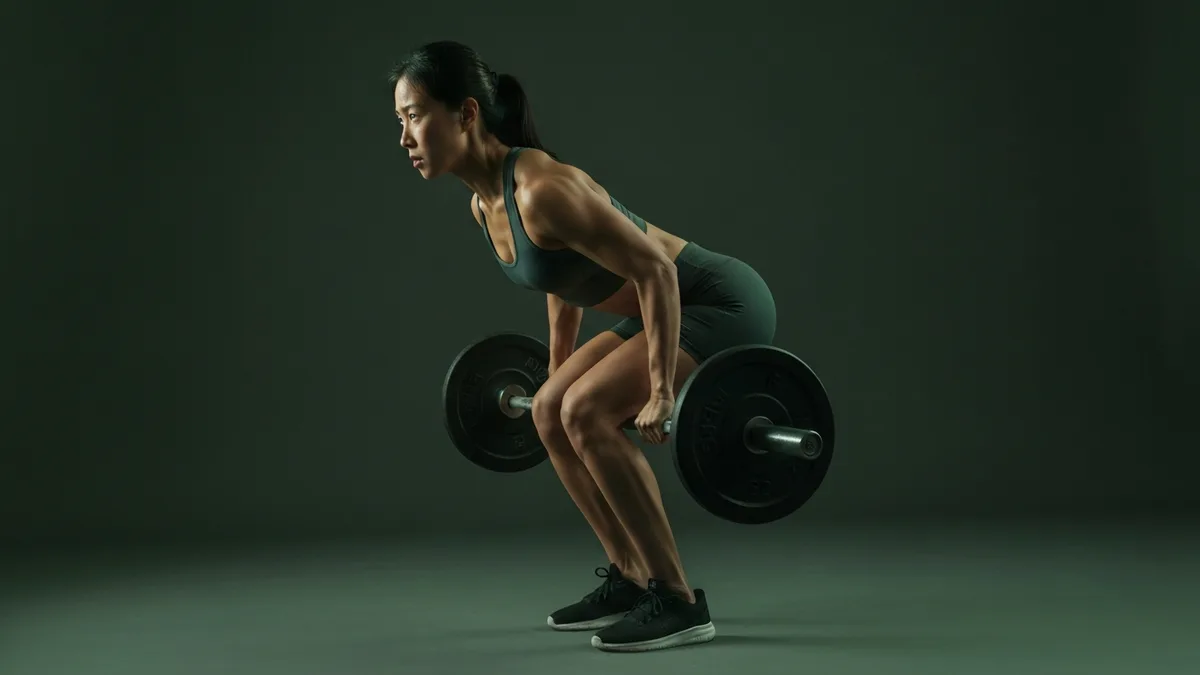
The barbell row works the latissimus dorsi, rhomboids, middle trapezius, rear deltoid, and teres major as pulling muscles, while the erector spinae, glutes, and hamstrings stabilize the hip-hinge position isometrically. This combination of heavy pulling and spinal stabilization makes the barbell row one of the most demanding — and most rewarding — back exercises.
How to Perform the Barbell Row
Stand with feet hip-width apart, barbell over mid-foot. Hinge at the hips by pushing the glutes back until your torso reaches roughly 30-45 degrees above parallel. Grip the bar just outside the knees with an overhand grip. Brace your core as if preparing for a punch.
Pull the bar toward the lower ribcage, driving the elbows back — not up. The elbows should track close to the body rather than flaring outward. Squeeze the shoulder blades together at the top for a one-count, then lower the bar under control to arm's length.
The torso angle should remain constant throughout the set. If your chest rises with every rep, you are using hip extension to cheat the weight up. This is the single most common barbell row mistake and the reason most lifters get lower back fatigue instead of upper back stimulus from rows.
Setup Details That Matter
Bar position. Start each rep with the bar at arm's length, not resting on the floor. Pendlay rows (from the floor) are a separate variation with a distinct purpose — standard barbell rows maintain tension throughout the set.
Hip hinge depth. The deeper the hinge, the more horizontal the torso, and the greater the lat and mid-back emphasis. But deeper hinges also increase erector spinae demand. If your lower back fatigues before your upper back, raise your torso angle by 10-15 degrees.
Knee bend. A slight knee bend (15-20 degrees) takes tension off the hamstrings and allows a more stable base. Straight-leg rows increase hamstring stretch but reduce stability.
Grip width. Hands just outside the knees (roughly shoulder width) balances range of motion and scapular retraction. Wider grips increase rhomboid and mid-trap emphasis. Narrower grips increase lat and biceps involvement.
Muscles Worked in Depth
Prime Movers
The lats perform shoulder extension — pulling the humerus backward from the flexed position. They are the strongest muscle during the pull and bear the most load, particularly through the mid-range of the movement.
The rhomboids and middle trapezius retract the scapulae at the top of each rep. Their contribution increases with wider grips and a more pronounced squeeze at peak contraction. These are the muscles responsible for the "thickness" feeling between the shoulder blades after a good row session.
The rear deltoid assists with shoulder horizontal abduction, particularly when the elbows flare slightly wider. Its role increases with wider grip positions.
The teres major assists the lat with shoulder extension and adduction, contributing most in the second half of the pull when the humerus passes the torso.
Stabilizers
The erector spinae contracts isometrically throughout every rep to maintain the hip-hinge position. This is a significant stability demand — the erectors at L4-L5 experience compressive forces several times bodyweight during heavy rows. This is why barbell rows can cause lower back fatigue and soreness even though the lower back is not the target.
The glutes and hamstrings stabilize the hip-hinge position, preventing the hips from drifting forward or the torso from rising during the set.
The biceps and forearms flex the elbow and maintain grip on the bar. Underhand grip variations increase biceps demand substantially.
Barbell Row Variations
| Variation | Torso Angle | Primary Emphasis | Best For |
|---|---|---|---|
| Standard overhand | 30-45 degrees | Lats, mid-traps, rhomboids | General back development |
| Pendlay row (from floor) | Parallel to floor | Lats, erectors (concentric) | Explosive pulling power |
| Underhand (Yates) row | 45-60 degrees | Lower lats, biceps | Lat thickness, arm development |
| Wide-grip row | 30-45 degrees | Rhomboids, mid-traps | Upper back thickness |
| Seal row (chest-supported) | Parallel (supported) | Lats, rhomboids | Removing lower back limitation |
The seal row (lying face-down on an elevated bench) deserves special mention. It eliminates the erector spinae demand entirely, allowing you to train the upper back pulling muscles without lower back fatigue as a limiter. This is invaluable for lifters whose lower back gives out before their upper back on standard barbell rows.
For a comparison with dumbbell alternatives, see our barbell row vs dumbbell row breakdown.
Common Mistakes
Torso rising during the pull. Using hip extension to assist the row reduces upper back stimulus and turns the movement into a partial deadlift. If your torso rises more than 5 degrees during a rep, the weight is too heavy or you are fatigued.
Pulling to the waist. Pulling the bar to the belly button instead of the lower ribcage reduces scapular retraction range and shifts emphasis away from the rhomboids and mid-traps.
No pause at contraction. Bouncing the bar off the torso and immediately lowering eliminates the peak contraction where the rhomboids and mid-traps work hardest. A one-second hold at the top significantly increases upper back activation.
Excessive lower back rounding. A rounded lumbar spine under row loads is a fast path to a pulled back muscle or disc issue. If you cannot maintain a neutral spine, reduce the weight or switch to a chest-supported variation.
Programming the Barbell Row
The barbell row handles moderate to heavy loads well but creates substantial systemic fatigue due to the isometric lower back demand. Most lifters benefit from placing rows early in the session when the erectors are fresh, then following with less fatiguing pulling movements like cable rows or pulldowns.
For hypertrophy, 3-4 sets of 8-12 reps works well. For strength, 4-5 sets of 5-6 reps with a focus on maintaining torso angle. Avoid going above 15 reps on barbell rows — the lower back typically fatigues before the upper back at high rep ranges, making cable rows or machine rows a better choice for pump work.
Program the barbell row 1-2 times per week as your heavy horizontal pull, supplemented by lighter rowing variations on other training days. For complete programming guidance, see how many back exercises per workout and optimal weekly back volume.
If your home gym lacks a barbell, cable rows with appropriate attachments provide a lower-back-friendly horizontal pull alternative. For bodyweight options, inverted rows covered in our calisthenics back workouts guide train a similar pattern.