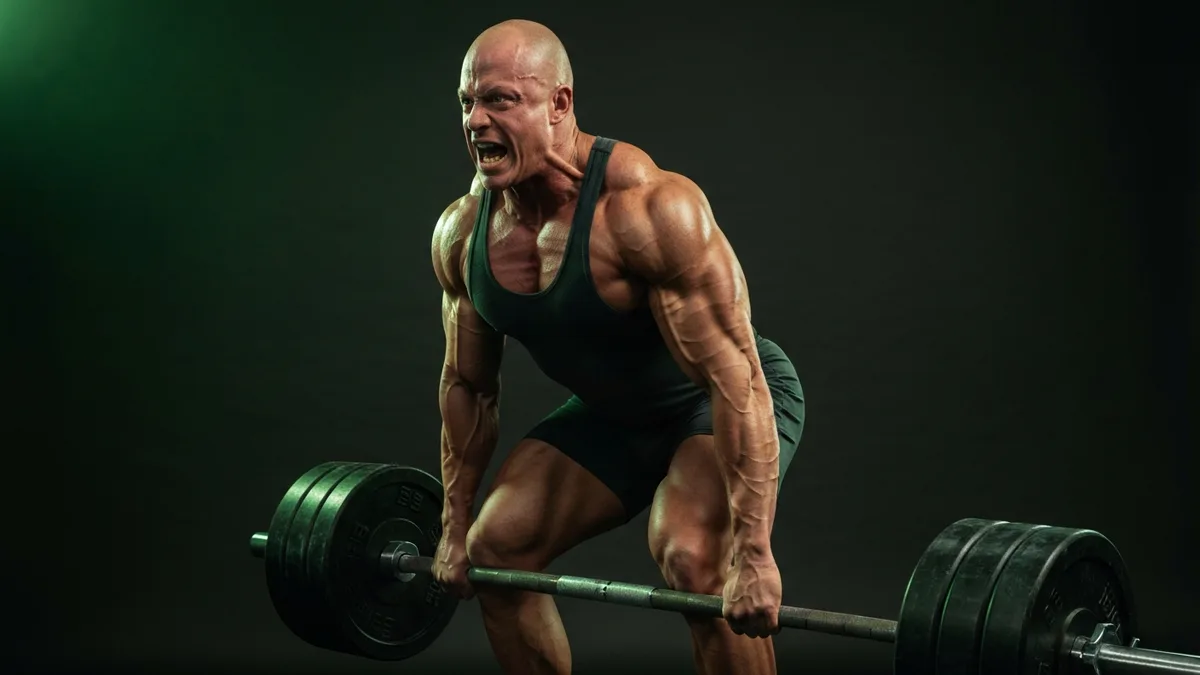
The deadlift works the gluteus maximus and hamstrings as the primary hip extensors, the quadriceps as knee extensors, the erector spinae as isometric spinal stabilizers, the latissimus dorsi as bar stabilizers, and the upper trapezius and forearms as grip and lockout muscles. The variation determines which of these groups bears the heaviest proportion of the load — conventional deadlifts emphasize the posterior chain and spinal erectors, sumo deadlifts emphasize the quads and hip adductors, and hex bar deadlifts distribute load more evenly.
Conventional Deadlift
The conventional deadlift positions the hands outside the knees with a hip-width stance. This setup creates a longer moment arm between the bar and the hips, increasing the demand on the posterior chain and spinal extensors.
Muscles Worked
Glutes and hamstrings — the primary hip extensors. They generate the force that drives the bar from the floor to lockout. The glutes contribute most through the mid-range and top of the lift; the hamstrings work hardest off the floor and through the first third of the pull.
Erector spinae — the heaviest isometric demand of any common exercise. The erectors at L4-L5 experience compressive forces of 6-10 times bodyweight during heavy conventional deadlifts. They do not shorten or lengthen — they hold the spine rigid against the massive flexion moment created by the load in front of the body. This isometric demand is what makes deadlifts so effective for building spinal stiffness and so fatiguing for the lower back.
Latissimus dorsi — contracts isometrically to keep the bar against the body. If the lats disengage, the bar drifts forward, increasing the spinal moment arm and the load on the erectors. "Bend the bar around your shins" is a common coaching cue that targets lat engagement.
Upper trapezius — resists scapular depression under the weight of the bar and contributes to the lockout shrug. Heavy deadlifts are one of the strongest upper trap builders, even without intentional shrugging.
Quadriceps — extend the knees during the first half of the pull. Their contribution is significant but less dominant than in squat variations.
Forearms and grip — maintain hold on the bar. Grip is a common failure point above 80% of max, which is why mixed grip, hook grip, and straps are used at heavy loads.
Sumo Deadlift
The sumo stance is wide (1.5-2x shoulder width) with toes pointed outward and hands inside the knees. This geometry creates a more upright torso and shorter bar path compared to conventional.
How Muscle Emphasis Shifts
The more upright torso reduces the spinal moment arm, lowering erector spinae demand by 8-10% compared to conventional. This makes sumo a practical alternative for lifters whose lower back is a limiter.
The wide stance increases demand on the hip adductors (inner thigh muscles) and shifts more work to the quadriceps due to greater knee flexion at the start position. Glute and hamstring contribution remains high but is distributed differently — the glutes are more involved off the floor due to the externally rotated hip position.
Lat and upper trap demands are similar between conventional and sumo — the bar still hangs from the arms and the spine still needs to be stabilized, just at a different angle.
Hex Bar (Trap Bar) Deadlift
The hex bar places the handles beside the body rather than in front of it. This seemingly small change has a large mechanical effect: the load aligns closer to the body's center of mass, reducing the spinal moment arm significantly.
Muscle Activation Differences
Erector spinae demand drops substantially — studies show 10-15% less spinal loading compared to conventional deadlifts at the same weight. This makes the hex bar the most lower-back-friendly deadlift variation.
Quadriceps involvement increases — the high-handle hex bar allows deeper knee flexion, creating a more squat-like movement pattern. Low-handle hex bar deadlifts more closely replicate the conventional hip-hinge pattern.
Lat demand decreases — with the load beside the body instead of in front, there is less tendency for the bar to drift forward. The lats still stabilize but are not working as hard to keep the load close.
The hex bar is an excellent choice for athletes who want posterior chain development without heavy spinal loading, and for lifters returning from lower back injuries.
Romanian Deadlift (RDL)
The RDL starts from the top position and involves a controlled descent to mid-shin level with minimal knee bend. The torso remains hinged throughout — there is no floor contact and no concentric phase off the ground.
Muscle Emphasis
The RDL places the highest relative demand on the hamstrings of any deadlift variation because the nearly straight leg maximizes the hip extension moment arm while minimizing quad contribution.
The erector spinae works isometrically through a large range of hip flexion. Unlike the conventional deadlift where the erectors engage mainly in the bottom half, the RDL demands sustained erector contraction through the entire set. This makes RDLs particularly effective for building erector endurance — but also particularly fatiguing for the lower back at higher rep ranges.
The glutes work hardest at the transition point where hip extension reverses from eccentric to concentric — the deepest point of the hinge.
Variation Comparison
| Variation | Erector Demand | Quad Demand | Hamstring Demand | Glute Demand | Lat Demand |
|---|---|---|---|---|---|
| Conventional | Very high | Moderate | High | High | High (isometric) |
| Sumo | High | High | Moderate-high | High | Moderate (isometric) |
| Hex bar (high handle) | Moderate | High | Moderate | High | Low-moderate |
| Romanian | Very high (sustained) | Low | Very high | High | Moderate (isometric) |
Deadlifts and Back Development
Deadlifts build the back through isometric loading — the erectors hold, the lats stabilize, and the traps resist depression. This builds thickness, stiffness, and the capacity to maintain posture under heavy loads. However, deadlifts do not train the back muscles through a full range of motion.
For complete back development, deadlifts need to be paired with exercises that train the lats through shoulder extension (pulldowns, pull-ups) and the upper back through scapular retraction (barbell rows, cable rows). The deadlift handles the erector and posterior chain component; rows and pulls handle the rest.
For a framework that integrates deadlifts with other back exercises, see our guide on how the back muscle groups work together and our exercise selection guide.
Programming Deadlifts for Back Training
In a back-focused program, deadlifts serve as the heavy compound foundation — they load the posterior chain and spinal stabilizers in a way no other exercise matches.
For strength: 3-5 sets of 3-5 reps, once per week. Conventional or sumo based on body proportions and comfort. Keep accessory back extensions and erector work in higher rep ranges on separate days.
For hypertrophy: 3-4 sets of 6-10 reps. Romanian deadlifts and hex bar deadlifts are better suited for hypertrophy rep ranges because the sustained time under tension is more manageable than grinding heavy conventional singles.
For back health: 2-3 sets of 8-12 reps with hex bar or RDL variations that reduce peak spinal loading while still training the posterior chain. Pair with back extensions for direct erector work through full range.
For lower back pain management around deadlifts, see our dedicated guide on lower back pain after deadlifts. For home gym deadlift equipment, our equipment guide covers barbell, hex bar, and kettlebell options.