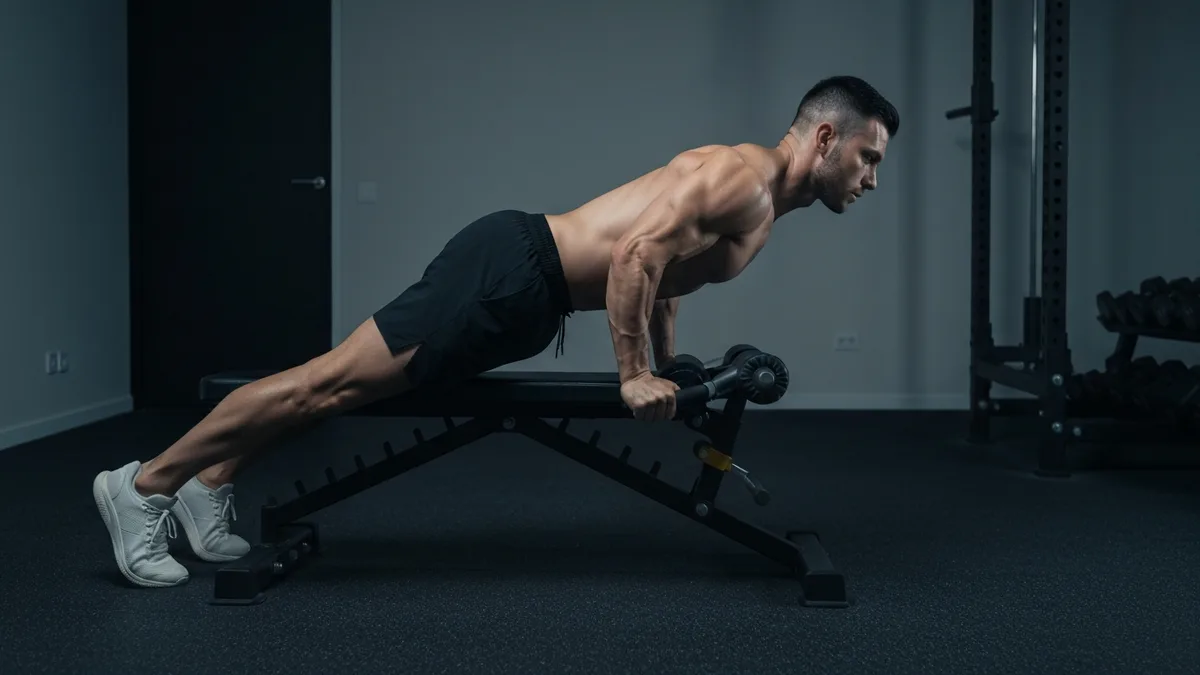
The best back extension bench for a home gym is a 45-degree hyperextension bench with an adjustable hip pad height, wide foot platform, and sufficient padding. This design accommodates all body sizes, allows progressive loading with weight plates, and trains the erector spinae, glutes, and hamstrings through a safe range of motion. Prices range from $80 for basic models to $400+ for commercial-grade units.
Types of Back Extension Benches
45-Degree Hyperextension Bench
The most common and most versatile option. The pad sits at a 45-degree angle, placing you in a partially inverted position with the hips supported and the torso free to flex and extend.
This angle is ideal because it loads the erectors progressively — the resistance (gravity acting on your torso) increases as you lower toward the floor and decreases as you return to the starting position. This self-regulating loading pattern makes the exercise safer than flat-bench variations where the loading is constant and maximum throughout the range.
Best for: General back extension training, weighted back extensions, glute-focused hip extensions, and home gym use where space and budget are considerations.
Roman Chair (90-Degree)
Positions the body horizontally (parallel to the floor at the starting position). The full 90-degree angle means gravity loads the torso maximally at the bottom of the movement. This is more demanding on the lower back than the 45-degree version.
Best for: Advanced lifters with established erector endurance who need greater loading without external weight. Not recommended as a first back extension bench for beginners — the horizontal start position can produce excessive lumbar stress in people without adequate isometric stability.
GHD (Glute-Ham Developer)
A larger, more expensive machine that enables both back extensions and glute-ham raises (knee flexion against resistance). The GHD positions the knee pad lower and includes a larger foot plate, allowing two distinct exercises on the same machine.
Best for: Lifters who want both back extension and hamstring training in one piece of equipment, CrossFit-style training, and gym owners who need multi-exercise stations. The GHD is the most capable option but requires more space (typically 5-6 feet long) and costs $400-1000.
Portable/Folding
Lightweight benches that fold flat for storage. Suitable for small spaces where permanent equipment placement is not possible.
Best for: Apartments, shared spaces, and people who cannot dedicate permanent floor space to a back extension station. Trade-off: lower weight capacity (usually 250-300 lbs total), less padding, and less stability than fixed-frame models.
Features That Matter
Adjustable hip pad height. The hip pad should adjust up and down to accommodate different torso lengths. Proper positioning places the top of the pad just below the hip crease (the inguinal fold) — if the pad is too high, it restricts hip movement; too low, and it pushes into the thighs rather than supporting the hips.
Wide, stable foot plate. Your feet anchor the entire movement. The foot plate should be wide enough for a comfortable stance (at least 12 inches between the uprights) and have a non-slip surface. Narrow foot plates force the ankles into an uncomfortable position and reduce stability during heavy sets.
Adequate padding. The hip pad should be at least 3 inches thick with firm foam — too thin and it creates uncomfortable pressure on the hip bones during loaded sets. The ankle pads should also be padded to prevent bruising during long sets.
Weight capacity. Verify the frame and pad support your bodyweight plus any additional load you plan to hold. A 200 lb lifter holding a 45 lb plate needs a bench rated for at least 250 lbs. Most quality home gym benches are rated for 300-500 lbs.
Frame stability. The bench should not wobble or shift during the exercise. Wider base frames and rubberized feet provide better stability. Test by pressing laterally on the frame — any significant flex indicates inadequate construction.
Exercises You Can Perform
A back extension bench is not a single-exercise tool. Beyond the standard back extension, it enables:
Weighted back extensions: Hold a weight plate against the chest or behind the head while performing the extension. This is the primary progressive overload method for the erectors on this bench.
Glute-focused extensions: Round the thoracic spine slightly and focus on hip extension rather than spinal extension. The glutes become the primary mover, making this an effective glute exercise alongside or instead of hip thrusts.
Side extensions (lateral flexion): Position the body sideways on the pad and perform lateral flexion. This trains the quadratus lumborum and obliques — the lateral stabilizers that most back training programs neglect.
Reverse hyperextensions: Lie face-down with the torso on the pad and the legs hanging. Raise the legs to horizontal. This trains glute and erector extension while decompressing the spine — the opposite loading pattern of a standard back extension.
For complete exercise technique, see our back extension form guide and erector spinae exercises.
Budget Recommendations
| Budget | Best Choice | Key Feature |
|---|---|---|
| Under $100 | Basic 45-degree bench | Functional but limited padding and adjustability |
| $100-200 | Adjustable 45-degree bench | Height-adjustable pad, decent padding, 300 lb capacity |
| $200-400 | Heavy-duty 45-degree bench | Commercial-grade padding, wide foot plate, 500+ lb capacity |
| $400-1000 | GHD machine | Back extensions + glute-ham raises, professional quality |
For how the back extension bench fits into a complete home setup, see our back workout equipment guide.