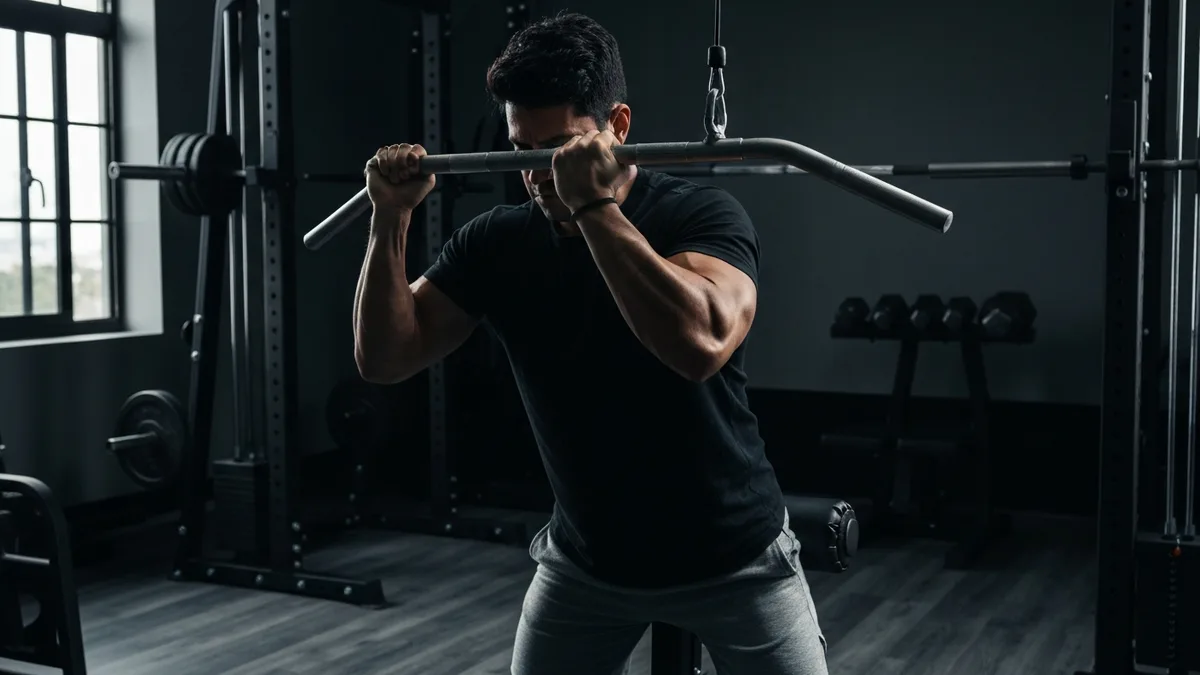
Cable row attachments shift the primary training stimulus between the lats, rhomboids, mid-traps, and rear delts by changing grip width, wrist orientation, and range of motion. Close neutral grips (V-handle) favor the lats through longer range of motion. Wide overhand grips favor the upper back retractors through wider scapular retraction. Single handles (D-grip) allow unilateral work. Ropes enable split-grip finishing positions that add rear delt activation.
V-Handle (Close Neutral Grip)
The most common cable row attachment. Two parallel handles 6-8 inches apart, palms facing each other.
Muscle emphasis: Lats (primary), lower traps, teres major, biceps. The narrow grip allows maximum elbow travel past the body, creating the longest range of motion for the lats. The neutral wrist position reduces forearm strain and allows heavier loading.
When to use: As your primary cable row attachment when lat development is the goal. The V-handle produces the most lat-specific stimulus of any row attachment because the close grip and full range of motion place the lats in their strongest pulling position.
Wide Overhand Bar
A straight or slightly curved bar, 24-36 inches wide, gripped with palms facing down (pronated).
Muscle emphasis: Rhomboids (primary), mid-traps, rear delts, lats (secondary). The wide grip limits elbow travel past the body but forces the shoulder blades through a wider retraction arc. The pulling path hits the mid-back retractors harder than any close-grip variation.
When to use: When upper back thickness between the shoulder blades is the priority. If you already train pulldowns for the lats, the wide-grip row fills the retractor gap without duplicating the lat stimulus.
Single D-Handle (Unilateral)
A single stirrup handle used one arm at a time. Each side trains independently.
Muscle emphasis: Depends on body positioning. Pulling to the hip targets the lat. Pulling to the lower rib cage targets the mid-back retractors. The unilateral loading also activates the obliques and quadratus lumborum as anti-rotation stabilizers.
When to use: When you need to address left-right strength imbalances, increase range of motion (each arm can travel further without the handle hitting the torso), or add a rotational stability challenge. Single-arm rows are the most effective exercise for correcting asymmetric back development.
Rope Attachment
A braided rope with rubber stoppers at the ends. The flexible nature allows the hands to split apart at peak contraction.
Muscle emphasis: Rear delts (when hands are split apart at the finish), rhomboids, mid-traps. The rope’s ability to split at the end position allows full scapular retraction plus shoulder external rotation — a combination that no rigid attachment can achieve.
When to use: As a face pull or high row attachment for rear delt and rotator cuff work. For standard cable rows, the rope produces less lat activation than rigid handles because the flexible grip reduces force transmission at heavy loads. Best used for moderate-weight, higher-rep work focusing on the squeeze at peak contraction.
MAG Grip (Angled Neutral)
Angled handles that place the wrists between pronation and supination. Available in wide, medium, and narrow configurations.
Muscle emphasis: Similar to the V-handle but with better ergonomics at heavy loads. The angled grip reduces wrist torque and allows heavier loading. The wide MAG grip provides a unique combination — wide hand spacing (rhomboid emphasis) with neutral wrist orientation (joint comfort).
When to use: When you want to row heavy without wrist strain, or when transitioning between close-grip lat emphasis and wide-grip retractor emphasis. The medium MAG grip is the best all-around attachment for lifters who want one handle that covers multiple emphasis patterns through body positioning.
Quick Comparison Table
| Attachment | Primary Target | Grip | ROM | Best For |
|---|---|---|---|---|
| V-handle | Lats | Close neutral | Longest | General lat development |
| Wide bar | Rhomboids/mid-traps | Wide pronated | Shortest | Upper back thickness |
| D-handle | Variable | Single neutral | Longest (unilateral) | Imbalance correction |
| Rope | Rear delts/rhomboids | Flexible neutral | Medium | Squeeze-focused work |
| MAG grip | Lats + retractors | Angled neutral | Medium-long | Heavy rows, joint comfort |
Programming Multiple Attachments
The most effective approach is rotating attachments across sessions rather than using the same one every time. This ensures all regions of the upper back receive direct stimulus over the training week.
Option 1 — Rotate by session: V-handle on Monday, wide bar on Thursday. This alternates lat emphasis and retractor emphasis across the week.
Option 2 — Two attachments per session: 3 sets with V-handle (lat emphasis), then 3 sets with wide bar (retractor emphasis). This covers both targets in a single session but requires more total sets.
Option 3 — Block periodization: Use one attachment for 4-6 weeks, then switch. This allows progressive overload on a specific pattern before introducing variation.
For the cable row technique behind each attachment, and how rows fit alongside pulldowns and barbell rows, our exercise guides cover programming for each variation.