A complete calisthenics back workout needs three movement patterns: a vertical pull (pull-ups and chin-ups for the lats), a horizontal pull (inverted rows for the upper back retractors), and a hip-hinge or extension (superman holds and bird dogs for the erector spinae). These three patterns cover the same muscle groups as a fully equipped gym — the progression is just different.
Vertical Pulls: Pull-Up Progressions
The pull-up is the cornerstone of bodyweight back training. It targets the lats, teres major, lower traps, and biceps through a full range of shoulder extension and adduction.
Beginner Progression (0 to First Pull-Up)
Dead hangs: Hang from the bar for 15-30 seconds. This builds grip endurance and shoulder stability while acclimating the joints to the hanging position. 3 sets daily.
Scapular pull-ups: From a dead hang, pull the shoulder blades down and together without bending the elbows. Rise about 2-3 inches. This isolates the lower traps and teaches scapular depression — the movement that initiates every proper pull-up.
Negative pull-ups: Jump or step to the top position, then lower yourself as slowly as possible (5-8 seconds). Eccentric strength transfers directly to concentric capacity. Perform 3-5 sets of 3-5 negatives, aiming to increase lowering time each week.
Band-assisted pull-ups: Loop a resistance band over the bar and place a knee or foot in the loop. The band provides the most assistance at the bottom (where you are weakest) and the least at the top. Progress by using thinner bands until you can perform a full unassisted rep.
Intermediate and Advanced Variations
Once you can perform 3 sets of 8-10 bodyweight pull-ups, progression comes from grip changes, tempo manipulation, and advanced variations:
Grip rotation: Alternate between wide overhand, shoulder-width overhand, neutral grip, and underhand (chin-up) across sessions. Each grip shifts lat fiber emphasis and biceps involvement, producing more complete development than any single grip alone.
Tempo pull-ups: 3-second concentric, 1-second pause at top, 3-second eccentric. The extended time under tension compensates for the inability to add weight.
Archer pull-ups: Pull toward one hand while the other arm extends to the side, providing assistance. This loads one lat more heavily than a standard pull-up and progresses toward one-arm pull-up capacity.
Weighted pull-ups: A dip belt, weighted vest, or a backpack with plates removes the bodyweight ceiling entirely. Adding 10-20 lbs to pull-ups turns them into one of the most effective heavy lat exercises available.
Horizontal Pulls: Inverted Rows
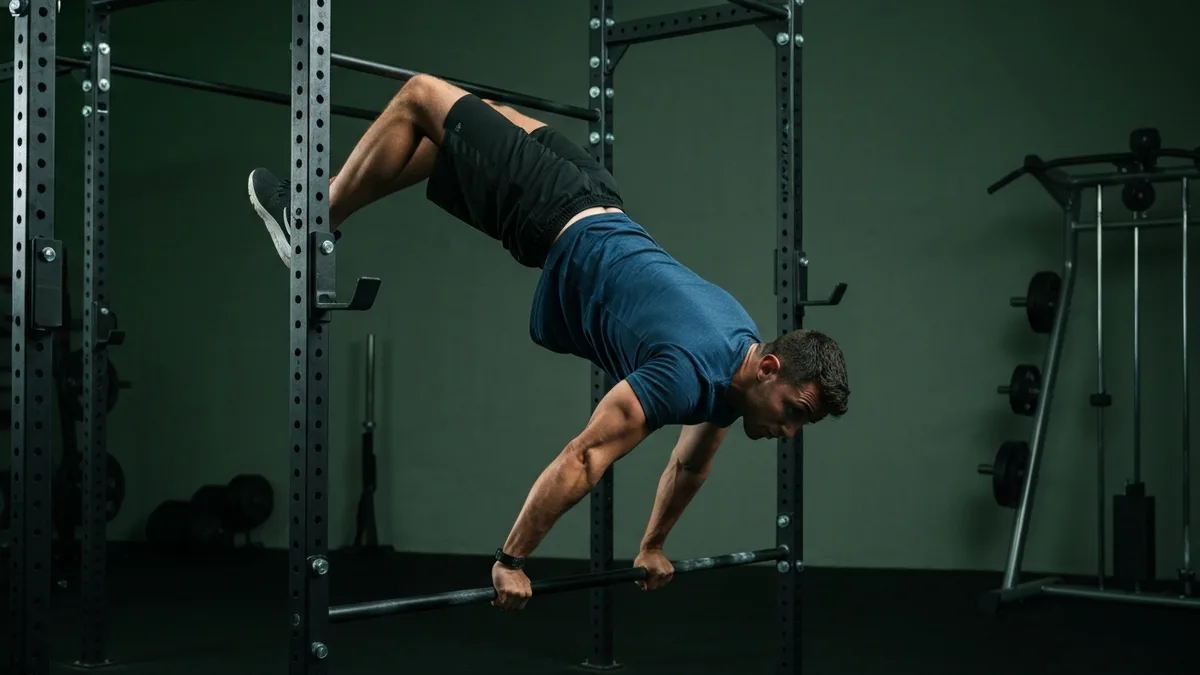
Inverted rows fill the same role in calisthenics that cable rows and barbell rows fill in a gym program — horizontal pulling that targets the rhomboids, middle traps, and rear delts.
Set a bar at waist height (a smith machine bar, a sturdy table edge, or gymnastics rings work). Hang underneath with arms extended, body straight from head to heels. Pull your chest to the bar, squeezing the shoulder blades together at the top.
Difficulty adjustments: A more horizontal body angle (feet elevated) is harder. A more upright angle (bar higher, feet closer to the bar) is easier. Gymnastics rings add instability that increases rotator cuff and stabilizer demand.
Inverted rows are particularly valuable for people who find barbell rows limited by lower back fatigue — the supine position eliminates erector spinae demand entirely.
Lower Back: Bodyweight Exercises
Training the lower back without equipment requires exercises that produce spinal extension or isometric stabilization against gravity.
Superman hold: Lie face down, extend both arms and legs, and lift everything off the floor. Hold for 5-10 seconds per rep, 3 sets of 8-10. This trains concentric and isometric erector function. For reduced intensity, lift only the upper body (arms extended) or only the legs.
Bird dog: The bird dog is the gold standard for bodyweight lower back stability. It trains the erectors and multifidus isometrically with an anti-rotation challenge. 3 sets of 6-8 reps per side, holding each for 6-10 seconds.
Reverse hyperextension off a bench: Lie face down on a bench with hips at the edge, legs hanging. Raise the legs until parallel with the torso. This trains the glutes and erectors while decompressing the spine — a movement that normally requires a specialized machine.
Glute bridge: Lying face up, feet flat on the floor, drive the hips toward the ceiling. While primarily a glute exercise, the bridge trains hip extension patterning that directly supports lower back function. Single-leg bridges increase difficulty and add pelvic stability demand.
Sample Calisthenics Back Workouts
Beginner (Cannot Do Pull-Ups Yet)
| Exercise | Sets x Reps | Rest |
|---|---|---|
| Dead hang | 3x15-30 seconds | 60 seconds |
| Negative pull-ups | 3x4-5 (5-second lowering) | 90 seconds |
| Inverted rows (upright angle) | 3x8-12 | 60 seconds |
| Superman hold | 3x8 (5-second holds) | 60 seconds |
| Bird dog | 3x6 per side (8-second holds) | 45 seconds |
Intermediate (8+ Pull-Ups)
| Exercise | Sets x Reps | Rest |
|---|---|---|
| Pull-ups (varied grip) | 4x6-10 | 90 seconds |
| Inverted rows (feet elevated) | 3x10-12 | 60 seconds |
| Archer pull-ups or tempo pull-ups | 3x4-6 | 2 minutes |
| Reverse hyper off bench | 3x12-15 | 60 seconds |
| Side plank | 3x20-30 seconds per side | 45 seconds |
Perform either workout 2-3 times per week. For complete back development, calisthenics can be supplemented with resistance bands for face pulls and pull-aparts — these address the upper back retractors that bodyweight pulling alone underserves.
For how bodyweight work fits alongside gym training, see how many back exercises per workout. For equipment upgrades, a doorway pull-up bar and a set of rings are covered in our back workout equipment guide.