Sway back posture occurs when the pelvis shifts forward relative to the feet while the thoracic spine rounds backward to maintain balance. This creates a characteristic slouch pattern — the hips push ahead of the ankles, the lumbar curve flattens, and the upper back rounds to compensate. Correcting it requires strengthening the glutes, deep abdominals, and erector spinae while releasing tight hip flexors and hamstrings.
What Sway Back Looks Like
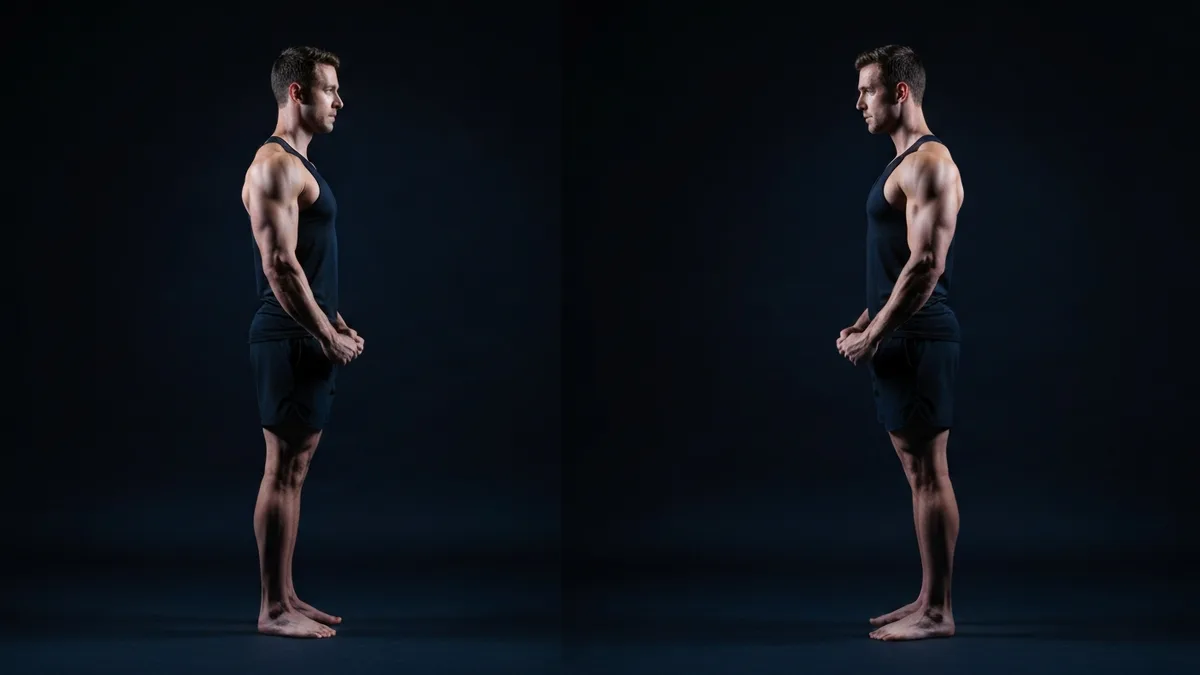
From the side, sway back posture has several recognizable features:
- The hips sit visibly forward of the ankles — the pelvis has drifted anteriorly
- The knees are hyperextended (locked straight or pushed backward)
- The lumbar curve is flattened rather than maintained — the lower back looks straight or slightly concave
- The thoracic curve is increased — the upper back rounds to keep the center of mass over the feet
- The head sits forward of the shoulders to compensate for the upper back rounding
This posture is extremely common in people who stand for long periods by "hanging" on their ligaments rather than actively supporting their posture with muscles. It feels relaxed — which is exactly why it develops. The body shifts to passive structures (ligaments, joint capsules) to avoid the metabolic cost of muscular support.
What Is Tight and What Is Weak
| Structure | Status in Sway Back | Why |
|---|---|---|
| Hip flexors (iliopsoas) | Shortened / tight | Pelvis has drifted forward, reducing hip flexor length |
| Hamstrings | Shortened / tight | Posterior pelvic tilt shortens hamstring resting length |
| Upper abdominals | Shortened / overactive | Trunk flexion posture keeps them in shortened position |
| Gluteus maximus | Weak / lengthened | Posterior pelvic tilt and hip extension slack reduce glute activation |
| Deep abdominals (transverse abdominis) | Weak | Not engaged during passive standing posture |
| Erector spinae (lumbar) | Weak / lengthened | Flattened lumbar curve reduces erector tone and activation |
| Upper back extensors | Weak / lengthened | Thoracic kyphosis overstretches the thoracic erectors and mid-traps |
The correction strategy follows directly from this table: strengthen everything that is weak, stretch everything that is tight.
Corrective Exercises
Glute Strengthening
Glute bridge with hold. Lie face up, feet flat on the floor, and drive the hips toward the ceiling. Squeeze the glutes at the top for 5 seconds. The hold is important — sway back posture is characterized by poor sustained glute activation, and timed holds train the muscle to maintain contraction rather than just produce a momentary pulse. 3 sets of 10-12 reps with 5-second holds.
Hip thrust. A progression from the glute bridge that allows heavier loading. Place your upper back on a bench and drive the hips upward with a barbell across the lap. This builds the glute strength needed to hold the pelvis in a neutral position during standing.
Deep Abdominal Activation
Dead bug. The dead bug trains the transverse abdominis to brace the core against extension forces. Lie on your back, arms toward the ceiling, knees bent at 90 degrees. Lower one arm overhead and the opposite leg toward the floor while pressing the lower back into the ground. 3 sets of 8 per side.
Pallof press. The anti-rotation demand recruits the deep abdominal wall alongside the obliques. This builds the trunk stiffness that prevents the pelvis from drifting forward during standing and walking. 3 sets of 8-10 per side.
Lower Back Extension Strengthening
Back extensions restore the lumbar erector activation that sway back posture has suppressed. The flattened lumbar curve reduces erector tone over time — the muscles adapt to a shortened demand and lose their ability to maintain a normal lordotic curve. Back extensions retrain them to hold extension.
Start with bodyweight, 3 sets of 15-20 reps. Focus on achieving a neutral spine at the top — not hyperextension, but the natural lordotic curve that sway back has eliminated.
Upper Back Strengthening
The thoracic rounding in sway back requires the same corrective approach as general rounded-shoulder posture. Face pulls, reverse flies, and band pull-aparts strengthen the rhomboids, middle traps, and lower traps that hold the thoracic spine in extension.
2-3 sets of 15-20 reps at the end of every training session. Consistency matters more than intensity for postural correction — daily low-dose exposure produces better results than weekly high-volume sessions.
Stretches for Sway Back
Hip flexor stretch (half-kneeling lunge): Kneel on one knee with the other foot forward. Tuck the pelvis under (posterior tilt) and shift weight forward until a stretch is felt in the front of the rear hip. Hold 30-60 seconds per side. The posterior tilt cue is essential — without it, the stretch bypasses the hip flexors and loads the lower back.
Hamstring stretch (supine): Lie on your back, one leg extended on the floor. Raise the other leg toward the ceiling, keeping it straight. Hold at the point of mild tension for 30-60 seconds per side. Active hamstring stretching (contracting the quadriceps to extend the knee) produces better results than passive stretching for sway back correction.
For additional stretching guidance, our decompression stretches and mid-back stretches guides cover complementary mobility work.
Daily Postural Awareness
Exercises correct the muscular imbalances, but conscious postural adjustments throughout the day accelerate the change. Three cues to practice during standing:
Pull the hips back over the ankles. If your hip bones sit forward of your ankle bones, shift your weight backward until they align. This immediately activates the glutes and engages the lumbar erectors.
Unlock the knees. Hyperextended knees are both a symptom and a sustainer of sway back. Maintaining a very slight knee bend keeps the quads engaged and prevents the pelvis from drifting forward.
Lift through the crown of the head. Imagining a string pulling upward from the top of the skull lengthens the spine, reduces thoracic kyphosis, and repositions the head over the shoulders. This single cue addresses the upper-back and head-forward components simultaneously.
For a broader look at how back muscle weakness creates postural problems, our lifestyle guide connects these patterns across the entire back musculature.