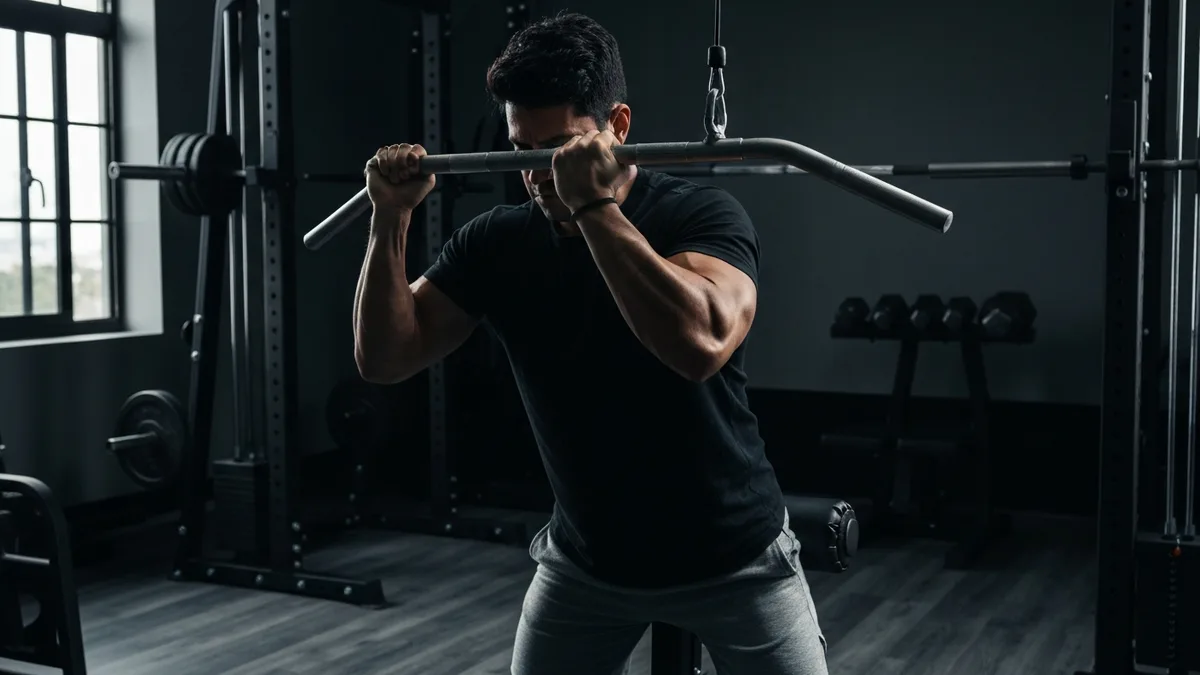
A T-bar row setup requires a barbell anchored at one end (using a landmine attachment or wedged into a corner) with weight plates loaded on the opposite end. You row the loaded end using a V-handle or T-bar handle positioned under the bar. This creates a fixed-arc rowing path that loads the lats, rhomboids, and erectors through an angle between a bent-over barbell row and a seated cable row.
Attachment Options
Landmine Attachment ($20-50)
A metal sleeve that bolts to the floor, a power rack, or a weight plate. The barbell end sits in the sleeve and pivots freely. This is the recommended setup for home gyms because it provides a stable anchor point, protects floors and walls, and enables dozens of landmine exercises beyond the T-bar row.
Floor-mount: Bolts directly to a platform or concrete floor. Most stable but requires permanent installation.
Rack-mount: Attaches to a power rack upright using the existing hole pattern. Ideal if you already own a rack — no floor modification needed.
Plate-mount: A weight plate sits on top of the base to hold it in place. No hardware installation required. Least stable of the three but adequate for most home gym loads.
Corner Setup (Free)
Wedge the barbell end into the corner where two walls meet. Place a folded towel behind the bar end to protect the walls. This works in a pinch but is not a long-term solution — the barbell will eventually damage the walls, and the pivot point is less stable than a landmine attachment.
T-Bar Row Handle ($20-40)
A dedicated handle that slides over the barbell sleeve and provides parallel grip handles at the loading end. This is the most comfortable grip option for T-bar rows because it places the hands at the correct width and angle without needing to improvise with cable attachments.
Alternatively, a V-handle (the same one used for cable rows) can be placed under the bar between the plates and gripped during the row. This is a free option if you already own a V-handle from your cable station.
Setting Up the T-Bar Row
Step 1: Secure the barbell in the landmine attachment (or corner). The empty end should be firmly anchored so it does not shift during the row.
Step 2: Load weight plates on the opposite end. Start with 25 lb plates rather than 45 lb plates — the smaller diameter allows greater range of motion because the plates do not contact your chest as early in the pull.
Step 3: Position your handle. Slide a T-bar handle over the sleeve, or place a V-handle under the bar between the innermost plate and the collar.
Step 4: Straddle the bar with feet at roughly shoulder width. Hinge at the hips until the torso is at approximately 45 degrees. Grip the handle, brace the core, and row.
T-Bar Row Form
The T-bar row follows the same principles as the barbell row with one key difference: the bar travels in a fixed arc rather than a straight vertical line. This arc loads the back differently at different points in the range — resistance is lightest at the bottom (where the bar is closest to the pivot) and heaviest at the top (where the moment arm is longest).
Hip hinge position: Maintain a flat or slightly arched lower back throughout. The erectors hold an isometric contraction to support the hip-hinge position while the lats and retractors perform the rowing movement.
Pull path: Drive the elbows back and up, pulling the handle toward the lower chest. At peak contraction, the shoulder blades should be fully retracted. Lower under control — the eccentric phase loads the lats through the same arc.
Torso angle: A more horizontal torso (closer to parallel with the floor) increases erector demand and shifts emphasis toward the lower lats. A more upright torso (closer to 60 degrees) reduces erector demand and shifts emphasis toward the upper back retractors.
Muscles Worked
The T-bar row provides a unique loading profile that differs from both barbell rows and cable rows. The fixed-arc path and the close neutral grip (when using a V-handle) produce high activation in the lats and rhomboids simultaneously, making it one of the most complete single-exercise back developers available.
The erector spinae work as isometric stabilizers throughout — similar to barbell rows but with slightly less erector demand because the arc reduces the forward moment arm compared to a straight barbell hanging from the hands.
Programming
T-bar rows work best as a primary or secondary back exercise in a pull session: 3-4 sets of 8-12 reps. They pair well with lat pulldowns (which cover the vertical pull pattern the T-bar row does not address) and reverse flies (which isolate the retractors at a different angle).
For lifters who find barbell rows limited by erector fatigue, the T-bar row often allows higher row volume because the reduced moment arm places less demand on the lower back stabilizers. This makes it an excellent alternative or complement to barbell rows.
For the complete home gym context, see our back workout equipment guide.